
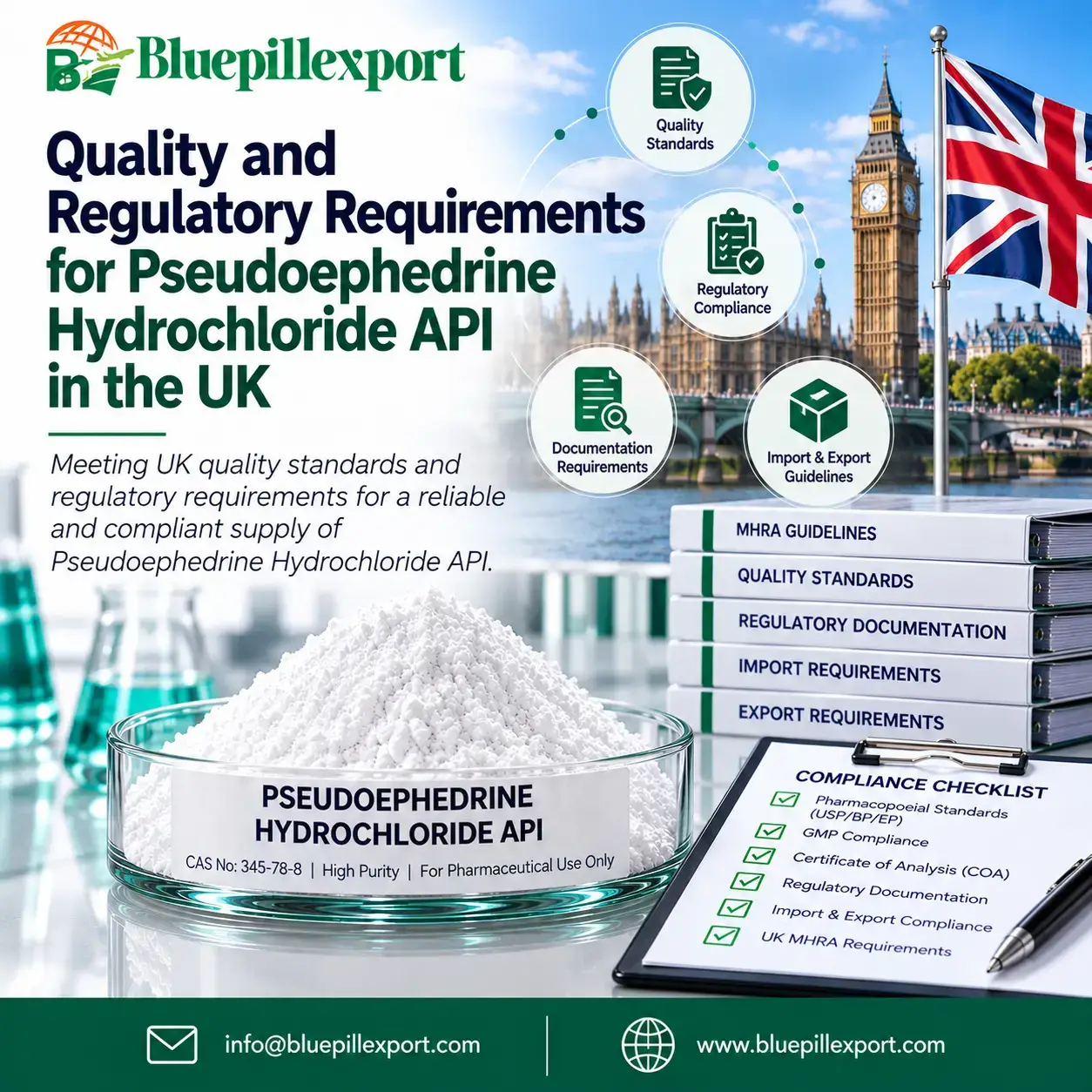
Quality and Regulatory Requirements for Pseudoephedrine Hydrochloride API in the UK
The United Kingdom’s pharmaceutical industry operates within a regulatory framework designed to protect medicine quality, patient safety, manufacturing integrity, and the security of pharmaceutical supply chains.
For Pseudoephedrine Hydrochloride API, quality assurance and regulatory compliance are particularly important because the substance has legitimate pharmaceutical applications while also being subject to drug precursor controls.
Pharmaceutical manufacturers, authorized importers, and other regulated organizations must consider product specifications, manufacturing-source qualification, Good Manufacturing Practice (GMP), analytical documentation, regulatory authorization, and supply-chain traceability.
BLUEPILL EXPORT PVT LTD, based in Surat, Gujarat, India, specializes in international Active Pharmaceutical Ingredient (API) and Pharmaceutical Intermediate sourcing and export coordination.
Our business emphasizes quality-focused pharmaceutical sourcing, manufacturing-source assessment, technical-documentation coordination, and responsible international B2B pharmaceutical trade.
This article explains the principal quality and regulatory considerations relevant to Pseudoephedrine Hydrochloride API in the United Kingdom.
Pseudoephedrine Hydrochloride API Product Overview
| Product Information | Details |
|---|---|
| Product Name | Pseudoephedrine Hydrochloride |
| Alternative Name | Pseudoephedrine HCl |
| CAS Number | 345-78-8 |
| Molecular Formula | C₁₀H₁₅NO·HCl |
| Product Category | Active Pharmaceutical Ingredient |
| Therapeutic Category | Sympathomimetic / Nasal Decongestant |
| Regulatory Classification | Category 1 drug precursor under applicable UK rules |
| Intended Application | Authorized Pharmaceutical Manufacturing |
| Target Market | United Kingdom |
| Company | BLUEPILL EXPORT PVT LTD |
Product specifications, pharmacopoeial compliance, documentation availability, and legal eligibility must be verified for each proposed transaction.
Understanding Pseudoephedrine Hydrochloride API
Pseudoephedrine Hydrochloride is an active pharmaceutical ingredient used in certain medicinal products intended to relieve nasal congestion.
It belongs to the sympathomimetic class of substances and acts through adrenergic mechanisms that can reduce swelling in nasal passages.
Its pharmaceutical applications are subject to relevant medicinal-product authorizations, manufacturing-quality requirements, and regulatory controls.
Pseudoephedrine is also a regulated drug precursor because it can be diverted into illicit drug manufacturing.
Consequently, organizations handling the substance must evaluate both pharmaceutical quality requirements and applicable precursor-control obligations.
Why Quality and Regulatory Compliance Matter
Pharmaceutical quality requirements help establish whether an API is suitable for its intended manufacturing application.
Regulatory controls establish whether the organizations involved are legally authorized to conduct particular activities.
For Pseudoephedrine Hydrochloride API, these responsibilities must be assessed independently.
A material may satisfy its approved pharmaceutical specification while still requiring separate legal authorization for importation, exportation, possession, or distribution.
Pharmaceutical Quality Requirements in the UK
UK pharmaceutical manufacturers must maintain appropriate quality systems for the raw materials used in medicinal-product manufacturing.
Relevant quality considerations include manufacturing-source qualification, approved product specifications, analytical testing, impurity control, documentation, packaging, storage, and traceability.
The purchasing organization’s qualified quality personnel should evaluate these factors according to its approved procedures.
Final material acceptance should be based on the applicable specification and relevant quality evidence.
Good Manufacturing Practice Requirements
Good Manufacturing Practice is an important component of pharmaceutical ingredient quality assurance.
When qualifying a Pseudoephedrine Hydrochloride API manufacturing source, pharmaceutical companies should assess applicable GMP expectations.
Relevant considerations may include manufacturing controls, quality-management systems, analytical testing, deviation management, change control, and documentation practices.
GMP-related documentation should be reviewed for the specific manufacturing source rather than assumed to be available or applicable.
Manufacturing Source Qualification
Manufacturing-source qualification helps pharmaceutical companies establish whether a supplier can meet their approved technical and quality requirements.
An appropriate assessment may consider the manufacturing source’s quality systems, product specifications, analytical capabilities, regulatory history where available, and relevant technical documentation.
Supplier audits or quality agreements may also be appropriate, depending on the purchasing organization’s quality system.
Final qualification decisions remain the responsibility of the pharmaceutical manufacturer’s authorized quality and regulatory personnel.
Pharmacopoeial Quality Standards
Pharmaceutical companies may require an API to meet a recognized pharmacopoeial specification.
Depending on the intended application, this may involve relevant BP, Ph. Eur., USP, or other recognized requirements.
The selected manufacturing source should provide suitable evidence supporting any claimed pharmacopoeial compliance.
A pharmacopoeial grade should never be assumed without verification of the manufacturer’s current documentation.
Certificate of Analysis Requirements
The Certificate of Analysis (COA) is an important document for pharmaceutical raw-material assessment.
A batch-specific COA records analytical results against the applicable specification.
Depending on the approved specification, relevant quality parameters may include identity, assay, related substances, residual solvents, and other required analytical characteristics.
The purchasing organization’s qualified quality personnel should determine whether the documented results satisfy the applicable acceptance criteria.
A COA does not replace any legally required precursor authorization.
Analytical Testing and Quality Control
Analytical testing supports confirmation that pharmaceutical ingredients meet established specifications.
Qualified manufacturers should use appropriate analytical procedures for the relevant material.
The suitability of analytical methods should be assessed according to applicable pharmacopoeial, regulatory, and quality-system requirements.
Additional testing may be required by the purchasing pharmaceutical manufacturer’s approved procedures.
Impurity Control and Product Quality
Impurity control is an important part of pharmaceutical API quality assurance.
Potential impurities may arise from manufacturing processes, raw materials, or product degradation.
Pharmaceutical companies should evaluate impurity information against the applicable product specification and regulatory requirements.
Any relevant impurity limits and analytical evidence should be reviewed by qualified quality personnel.
Stability, Retest Period and Storage
Pharmaceutical raw-material quality can be influenced by storage and handling conditions.
The selected manufacturer’s current technical documentation should guide relevant storage requirements, retest periods, and expiry information where applicable.
Pharmaceutical companies should maintain appropriate handling procedures and comply with relevant safety and regulatory obligations.
Packaging and Product Identification
Suitable packaging helps maintain API integrity and supports pharmaceutical supply-chain traceability.
Packaging should be appropriate for the material’s characteristics and relevant quality requirements.
Product identification, batch information, and associated records should satisfy the applicable quality and legal requirements.
Technical Documentation for UK Pharmaceutical Companies
Depending on the manufacturing source and applicable disclosure conditions, relevant documentation may include:
- Certificate of Analysis (COA)
- Product Specification
- Safety Data Sheet (SDS)
- Available GMP-related documentation
- Manufacturing-source information where authorized
- Packaging and storage information
- Relevant quality and traceability records
- Technical product information
The availability and suitability of individual documents must be verified for the selected manufacturing source.
MHRA Requirements for Active Pharmaceutical Ingredients
The Medicines and Healthcare products Regulatory Agency (MHRA) oversees relevant pharmaceutical regulatory matters in the United Kingdom.
UK businesses manufacturing, importing, or distributing active substances must assess applicable registration and good manufacturing or distribution practice obligations.
These pharmaceutical requirements are separate from chemical precursor licensing.
Organizations should determine which requirements apply to their specific activities using current MHRA guidance.
UK Drug Precursor Classification
Pseudoephedrine is listed as a Category 1 drug precursor under the applicable UK precursor-control framework.
Category 1 substances are subject to stringent controls because of their potential diversion into illicit drug manufacturing.
An important distinction exists between bulk Pseudoephedrine Hydrochloride API and certain medicinal preparations containing pseudoephedrine, which may be classified differently.
Businesses should confirm the relevant classification before assessing regulatory obligations.
UK Home Office Precursor Controls
The UK Home Office administers applicable domestic drug precursor controls.
Organizations handling Category 1 precursors must assess relevant licensing and compliance requirements.
Depending on the activity, these may involve domestic precursor licensing, transaction-specific authorizations, recordkeeping, customer verification, and other regulatory responsibilities.
The applicable requirements should be established before regulated activities proceed.
Import Requirements for Pseudoephedrine Hydrochloride API
Importation of Category 1 drug precursors into the United Kingdom is subject to specific regulatory controls.
The UK Home Office’s published guidance identifies individual consignment authorization requirements for Category 1 imports.
Organizations should also determine whether domestic precursor licensing and relevant pharmaceutical registration requirements apply.
The exact obligations must be assessed for the proposed transaction and jurisdiction.
Export Requirements for Pseudoephedrine Hydrochloride API
Exportation of Category 1 precursors from the United Kingdom is also subject to regulatory controls.
Home Office guidance identifies individual consignment authorization requirements and relevant pre-export notification obligations.
These requirements are separate from ordinary commercial documents and pharmaceutical quality records.
No proposed shipment should proceed without satisfying all applicable legal obligations.
Great Britain and Northern Ireland Considerations
Drug precursor regulations may differ between Great Britain and Northern Ireland because of their respective regulatory arrangements.
Organizations should establish which legal framework applies to their actual location and proposed activities.
Businesses should not assume that all movements involving the United Kingdom are subject to identical requirements.
Current official guidance should be consulted for jurisdiction-specific obligations.
Legitimate Pharmaceutical End-Use Verification
Legitimate end-use verification is an important part of responsible precursor-regulated pharmaceutical trade.
The intended pharmaceutical application should be established, and relevant organizations should be legally authorized for their activities.
Where the purchaser, importer, and final pharmaceutical manufacturer are different entities, their responsibilities should be appropriately documented.
Difference Between Quality Documentation and Regulatory Authorization
Quality documentation and regulatory authorization serve separate purposes.
| Quality Requirements | Regulatory Requirements |
|---|---|
| Certificate of Analysis | Applicable precursor licensing |
| Product Specification | Import/export authorization where required |
| GMP-related documentation | Business authorization |
| Manufacturing-source qualification | Legitimate end-use verification |
| Batch traceability | Regulatory recordkeeping |
A technically acceptable API does not automatically qualify for international trade.
Supply-Chain Traceability
Traceability supports pharmaceutical quality assurance and regulatory accountability.
Relevant records should appropriately identify the manufacturing source, product, batch, supplier, importer, authorized consignee, and legitimate pharmaceutical end use.
For precursor-regulated materials, traceability also contributes to diversion prevention and responsible supply-chain oversight.
Regulatory Risk Management
Pharmaceutical organizations should assess potential quality and regulatory risks before approving a proposed transaction.
Relevant concerns may include incomplete technical documentation, unsuitable manufacturing sources, specification mismatches, inadequate traceability, unclear end-use information, or unresolved legal requirements.
A structured review by qualified quality, regulatory, and compliance personnel can help address these issues.
Indian Export Compliance Considerations
Indian exporters involved in Pseudoephedrine Hydrochloride API transactions must evaluate the applicable Indian legal framework.
Relevant obligations may include pharmaceutical regulations, chemical precursor controls, export permissions, customs requirements, and international regulatory responsibilities.
Authorization in the United Kingdom does not replace any permissions required in India.
Both exporting and importing organizations must satisfy the legal requirements applicable to their respective activities.
Responsible International Pharmaceutical Trade
Pseudoephedrine Hydrochloride API has legitimate pharmaceutical applications but also presents diversion risks.
BLUEPILL EXPORT PVT LTD does not support anonymous procurement, concealed end users, false documentation, unauthorized distribution, or circumvention of chemical precursor controls.
All participating organizations must comply with applicable legal and regulatory requirements.
BLUEPILL EXPORT PVT LTD – API and Pharmaceutical Intermediate Supply
BLUEPILL EXPORT PVT LTD specializes in international Active Pharmaceutical Ingredient and Pharmaceutical Intermediate sourcing and export coordination.
Our business approach emphasizes quality-focused sourcing, manufacturing-source qualification, product specification coordination, technical-documentation review, regulatory awareness, and responsible B2B pharmaceutical trade.
Any proposed transaction involving Pseudoephedrine Hydrochloride API remains subject to applicable chemical precursor controls and legal authorization.
Official UK Regulatory Resources
Pharmaceutical companies should consult the following official sources when evaluating regulatory obligations.
- UK Home Office – Precursor Chemical Licensing
- UK Drug Precursor Classification
- UK Precursor Import and Export Authorization Requirements
- MHRA – Active Substance Registration
These resources should be read alongside applicable legislation and current official regulatory guidance.
Contact BLUEPILL EXPORT PVT LTD
Licensed pharmaceutical organizations seeking general information about our Active Pharmaceutical Ingredient and Pharmaceutical Intermediate business, quality-documentation practices, or regulatory-compliance approach may contact our team.
Company: BLUEPILL EXPORT PVT LTD
Business: Active Pharmaceutical Ingredients and Pharmaceutical Intermediates
Location: Surat, Gujarat, India
Website: www.bluepillexport.com
Email: info@bluepillexport.com
Conclusion
Understanding the Quality and Regulatory Requirements for Pseudoephedrine Hydrochloride API in the UK is essential for pharmaceutical organizations involved in handling this regulated ingredient.
Important considerations include manufacturing-source qualification, pharmaceutical quality standards, Certificate of Analysis review, GMP compliance, MHRA active-substance requirements, UK Home Office precursor controls, import/export authorization, and supply-chain traceability.
For precursor-regulated pharmaceutical ingredients, quality documentation and legal authorization must be independently established.
BLUEPILL EXPORT PVT LTD emphasizes quality-focused sourcing, technical-documentation coordination, responsible international pharmaceutical trade, and regulatory compliance within its Active Pharmaceutical Ingredient and Pharmaceutical Intermediate business.
Regulatory information is provided for general educational purposes. Pharmaceutical companies should verify current requirements with the relevant UK and Indian authorities before undertaking regulated activities.