
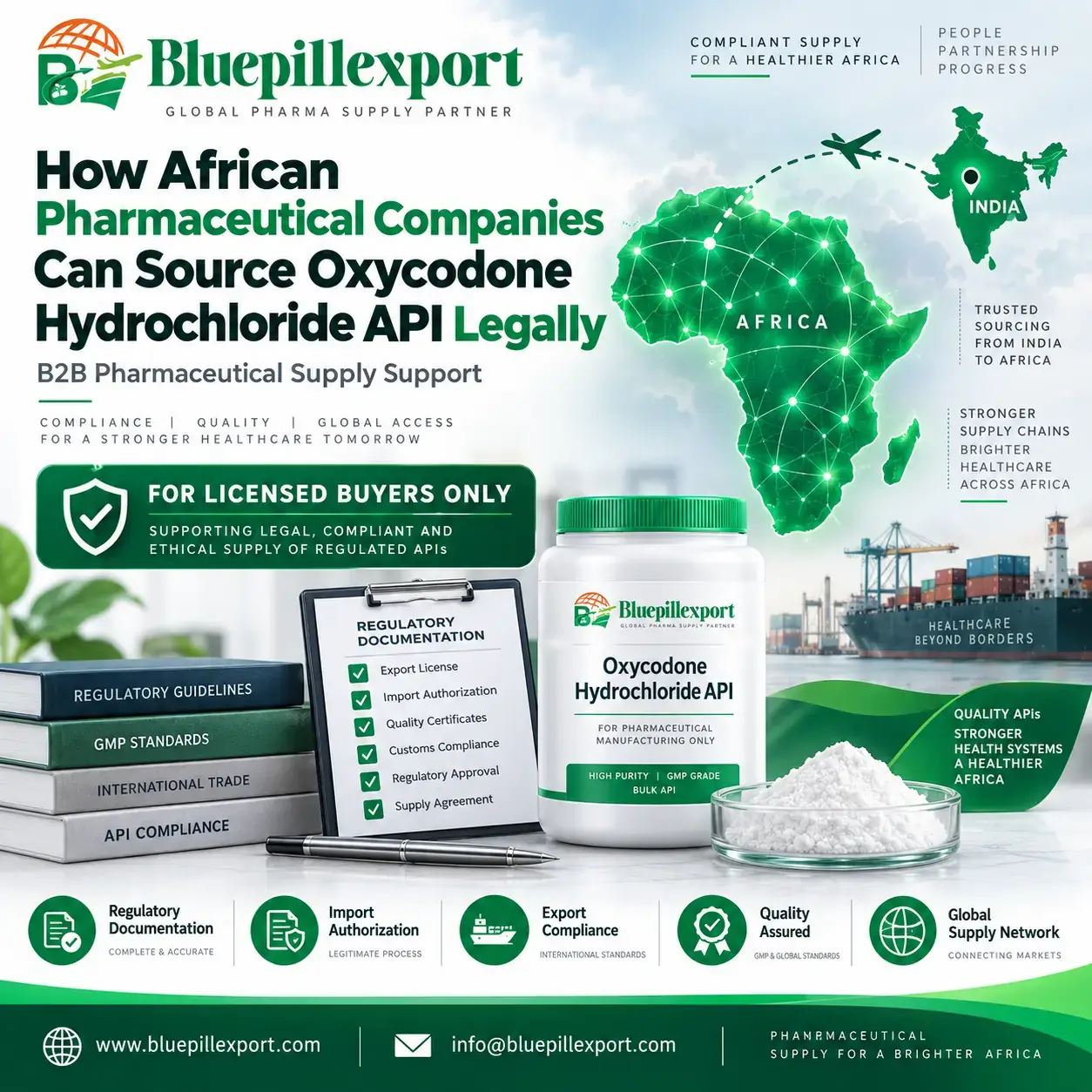
How African Pharmaceutical Companies Can Source Oxycodone Hydrochloride API Legally
Sourcing a controlled Active Pharmaceutical Ingredient requires a different procurement approach from buying conventional pharmaceutical raw materials. Pharmaceutical companies must address supplier qualification, product quality, controlled-substance licensing, legitimate pharmaceutical end use, import authorization, export permissions, documentation, logistics, and supply-chain traceability.
Oxycodone Hydrochloride API, commonly referred to as Oxycodone HCl API, is a controlled narcotic pharmaceutical ingredient. African pharmaceutical companies seeking this API should therefore establish the applicable legal and regulatory pathway before committing to a commercial transaction.
BLUEPILL EXPORT PVT LTD supports compliant international Oxycodone Hydrochloride API sourcing for appropriately licensed and authorized pharmaceutical organizations across Africa, subject to applicable controlled-substance laws, import/export permissions, legitimate pharmaceutical end use, and regulatory verification.
Our company specializes in international supply of Active Pharmaceutical Ingredients (APIs) and Pharmaceutical Intermediates for qualified B2B pharmaceutical organizations.
Oxycodone Hydrochloride API Overview
Product: Oxycodone Hydrochloride API
Common Name: Oxycodone HCl API
Category: Active Pharmaceutical Ingredient
Classification: Controlled / Narcotic Pharmaceutical Ingredient
Intended Application: Authorized Pharmaceutical Manufacturing
Supply Model: Regulated International B2B Supply
Market: Africa
Supplier: BLUEPILL EXPORT PVT LTD
Exact specifications, manufacturing source, documentation, quantity, packaging, and shipment eligibility should be evaluated individually for each qualified transaction.
Step 1: Confirm That Your Company Is Authorized
The first step should be determining whether the organization is legally authorized to procure and handle the controlled API in its jurisdiction.
Depending on national law and the company’s role, relevant authorization may involve:
- Pharmaceutical manufacturing license
- Pharmaceutical import license
- Controlled-substance authorization
- Authorization to possess or handle controlled pharmaceutical substances
- API import authorization
- Other product- or activity-specific permissions
A standard company registration or general pharmaceutical trading license should not automatically be assumed to authorize handling of Oxycodone Hydrochloride API.
Step 2: Review the Rules in Your Specific African Market
There is no single regulatory pathway covering the entire African continent.
Requirements in Ghana may differ from Nigeria, Kenya, South Africa, Tanzania, Uganda, Zambia, Zimbabwe, Botswana, Angola, Mozambique, Senegal, Democratic Republic of the Congo, Egypt, Morocco, Tunisia, Algeria, and other African markets.
Before sourcing, the pharmaceutical company should determine the rules applicable to its specific country, including requirements concerning:
- Controlled-substance importation
- Pharmaceutical manufacturing
- API procurement
- Storage and handling
- Authorized quantities
- Import permits
- Customs clearance
- Pharmaceutical end use
Professional local regulatory or legal advice may be appropriate where requirements are unclear.
Step 3: Define the Pharmaceutical Manufacturing Requirement
A clear procurement requirement helps qualified suppliers evaluate technical, commercial, and regulatory feasibility.
The pharmaceutical company should establish information such as:
- Required API
- Required specification
- Intended pharmaceutical manufacturing purpose
- Required commercial quantity
- Destination country
- Manufacturing facility
- Importer
- Required documentation
- Packaging requirements
- Procurement schedule
Controlled-substance permissions and import-permit status should also be identified early in the process.
Step 4: Establish a Legitimate Pharmaceutical End Use
Controlled API procurement requires a legitimate and identifiable pharmaceutical purpose.
Where the importer and manufacturer are different organizations, the supply chain may need to identify both parties.
Depending on applicable requirements, end-use information may include:
- Licensed pharmaceutical manufacturer
- Manufacturing facility
- Intended pharmaceutical manufacturing purpose
- Licensed importer
- Authorized consignee
- Requested quantity
- Controlled-substance authorization
- Relevant regulatory approvals
Clear end-use information supports regulatory review and supply-chain traceability.
Step 5: Identify a Qualified Oxycodone HCl API Source
Once the buyer has established its regulatory position, it can evaluate appropriate API sources.
Manufacturing-source assessment may consider:
- Product specification
- Manufacturing quality systems
- Technical documentation
- Regulatory suitability
- Commercial availability
- Batch documentation
- Quantity availability
- Packaging configuration
- Supply continuity
- Export feasibility
BLUEPILL EXPORT PVT LTD coordinates manufacturing-source identification according to qualified pharmaceutical customer requirements.
Step 6: Qualify the Manufacturing Source
Identifying a supplier and qualifying an API manufacturer are not the same process.
Before commercial procurement, the buyer’s quality, technical, and regulatory teams should evaluate whether the proposed manufacturing source is suitable for the intended pharmaceutical application.
Qualification may involve review of:
- Manufacturing quality systems
- Product specification
- Available quality documentation
- Batch documentation
- Regulatory suitability
- Supply capacity
- Packaging
- Storage information
- Supplier traceability
Final approval should follow the buyer’s established supplier-qualification procedures.
Step 7: Review the API Specification
The pharmaceutical manufacturer should compare the proposed API specification with its technical and regulatory requirements.
Depending on the applicable specification, evaluation may include parameters relating to:
- Identification
- Assay
- Purity
- Related substances
- Impurity profile
- Other specified quality criteria
Final acceptance should be based on the selected manufacturer’s current specification and applicable batch-specific documentation.
Step 8: Review the Certificate of Analysis
A Certificate of Analysis (COA) is an important part of API quality evaluation.
The relevant batch-specific COA should be reviewed by qualified technical or quality personnel against the applicable specification before final material acceptance.
A COA demonstrates analytical information associated with the batch. It does not constitute permission to import or export a controlled pharmaceutical substance.
Step 9: Confirm Available Technical Documentation
Depending on the selected manufacturing source, applicable disclosure conditions, and regulatory requirements, documentation may include:
- Certificate of Analysis
- Product Specification
- Safety Data Sheet
- GMP-related documentation where applicable
- Manufacturing-source information where authorized
- Technical product documentation
- Certificate of Origin
- Commercial and shipment documentation
Document availability varies by source and should be confirmed during procurement rather than assumed.
Step 10: Obtain the Required Controlled-Substance Authorization
A pharmaceutical manufacturing or import license may not by itself provide authority to handle every controlled substance.
The buyer should determine whether additional controlled-substance permissions are required for the proposed activity.
Depending on local law, authorization may relate to:
- Procurement
- Importation
- Possession
- Storage
- Pharmaceutical manufacturing
- Distribution or transfer
Only appropriately authorized organizations should participate in the controlled API supply chain.
Step 11: Obtain the Applicable Import Permit
Where a shipment-specific controlled-substance import permit is required, the licensed importer should obtain it through the appropriate legal process before shipment.
Depending on the jurisdiction, the authorization may identify or relate to:
- Controlled substance
- Licensed importer
- Authorized quantity
- Pharmaceutical end use
- Authorized consignee
- Supplier or exporter
- Country of origin
- Permit validity
The buyer remains responsible for establishing the exact destination-country requirements.
Step 12: Ensure the Authorized Quantity Matches the Requirement
Quantity is particularly important when procuring a controlled API.
The quantity eligible for supply may depend on:
- Manufacturing requirements
- Controlled-substance authorization
- Import permit
- Approved pharmaceutical end use
- Export authorization
- Applicable quotas or regulatory limits
- Manufacturing-source availability
A purchase order for a particular quantity does not itself authorize international shipment of that quantity.
Step 13: Confirm Export Authorization
Legal import authorization in the African destination market does not necessarily complete the process.
The country from which Oxycodone Hydrochloride API is exported may separately require controlled-substance export authorization.
Export eligibility can depend on:
- Valid destination-country import authorization
- Product classification
- Buyer credentials
- Authorized quantity
- Destination country
- Consignee information
- Legitimate pharmaceutical end use
- Applicable export controls
The exporter should establish the applicable requirements before dispatch.
Step 14: Coordinate Import and Export Documentation
Controlled API transactions require consistency between relevant regulatory, commercial, and transportation documents.
Information concerning the product, quantity, buyer, importer, exporter, consignee, destination, and end use should correspond appropriately across applicable documentation.
Material discrepancies should be addressed before shipment.
Step 15: Prepare Commercial Shipping Documents
After regulatory eligibility has been established, applicable commercial documentation can be coordinated.
Depending on the transaction, documents may include:
- Commercial Invoice
- Packing List
- Certificate of Origin
- Certificate of Analysis
- Available technical documentation
- Applicable regulatory documents
- Export documentation
- Transportation documents
The exact document package depends on the source, destination, transaction structure, and applicable regulations.
Step 16: Plan Compliant International Logistics
Controlled pharmaceutical ingredients require carefully coordinated international transportation.
Shipment feasibility may depend on:
- Import authorization
- Export authorization
- Approved quantity
- Authorized consignee
- Customs requirements
- Carrier acceptance
- Security requirements
- Packaging
- Transportation route
- Product classification
Logistics arrangements should be finalized only when the relevant regulatory requirements have been satisfied.
Step 17: Maintain End-to-End Traceability
Traceability helps protect the integrity of the legitimate pharmaceutical supply chain.
A controlled API transaction should clearly identify relevant parties and information such as:
- API manufacturer
- Supplier
- Exporter
- Licensed importer
- Authorized consignee
- Pharmaceutical manufacturer
- Approved pharmaceutical end user
- Product identity
- Batch information
- Authorized quantity
- Applicable permits
- Shipment documentation
African pharmaceutical companies should avoid anonymous, unidentified, or unverifiable controlled API supply channels.
Step 18: Maintain Appropriate Storage and Records
After legally authorized receipt, the pharmaceutical organization should follow the manufacturer’s applicable storage and handling documentation together with all destination-country controlled-substance requirements.
Depending on applicable law and company responsibilities, appropriate inventory, receipt, transfer, manufacturing, and other required records may also need to be maintained.
These controls support accountability and traceability throughout legitimate pharmaceutical use.
Step 19: Plan Repeat Procurement in Advance
Recurring controlled API procurement requires careful planning.
Where legally permitted, pharmaceutical companies can coordinate:
- Production forecasts
- Raw-material requirements
- Source availability
- Technical qualification
- Regulatory timelines
- Permit planning
- Procurement schedules
- Inventory requirements
- Shipment planning
- Supply continuity
A previous successful import should not automatically be treated as authorization for a future shipment. Each transaction remains subject to the permissions applicable at the relevant time.
Documents Buyers Should Prepare Before Contacting a Supplier
A qualified African pharmaceutical buyer can make the initial sourcing assessment more efficient by preparing the relevant documentation before requesting commercial supply.
Typical information may include:
- Company profile and registration
- Pharmaceutical manufacturing or import license
- Controlled-substance authorization
- Destination country
- Intended pharmaceutical use
- Required specification
- Commercial quantity
- Import-permit status
- Authorized consignee
- End-user details where applicable
- Required technical documentation
The exact requirements will depend on the destination jurisdiction and transaction.
Common Compliance Mistakes to Avoid
Controlled API procurement can encounter problems when commercial sourcing begins before regulatory eligibility has been established.
Common issues include expired licenses, incomplete buyer documentation, unclear end use, missing controlled-substance permissions, quantity differences between commercial and regulatory documents, incorrect consignee information, missing import authorization, or treating technical documents such as a COA as substitutes for regulatory permits.
Addressing regulatory requirements early can help create a more transparent and properly documented procurement process.
How BLUEPILL EXPORT PVT LTD Supports Licensed Buyers
BLUEPILL EXPORT PVT LTD specializes in international Active Pharmaceutical Ingredient and Pharmaceutical Intermediate supply.
For appropriately authorized controlled API requirements, our approach emphasizes:
- Compliance-first sourcing
- Buyer qualification
- Manufacturing-source identification
- Quality-focused source evaluation
- Technical documentation coordination
- Regulatory-document coordination
- Export documentation support
- International logistics coordination
- Supply-chain traceability
- Long-term procurement planning where legally permitted
Our role is focused exclusively on legitimate B2B pharmaceutical supply channels.
Responsible Oxycodone Hydrochloride API Sourcing
Oxycodone Hydrochloride is a controlled narcotic pharmaceutical ingredient with significant misuse and diversion risks.
BLUEPILL EXPORT PVT LTD considers requirements only from appropriately licensed and authorized pharmaceutical organizations for legitimate pharmaceutical purposes.
We do not support controlled API procurement for personal use, direct consumer supply, anonymous transactions, unauthorized distribution, unlicensed manufacturing, or transactions where the necessary regulatory permissions cannot be established.
Buyers, importers, and manufacturers remain responsible for complying with all applicable laws and obtaining the licenses, permits, and authorizations required in their respective jurisdictions.
Submit Your Oxycodone Hydrochloride API Requirement
Appropriately authorized African pharmaceutical organizations seeking to source Oxycodone Hydrochloride API may contact BLUEPILL EXPORT PVT LTD for an initial sourcing and compliance assessment.
Qualified inquiries should provide:
- Company name
- Destination country
- Pharmaceutical manufacturing/import license
- Controlled-substance authorization
- Intended pharmaceutical use
- Required API specification
- Required commercial quantity
- Import-permit status
- Authorized consignee details
- Required technical documentation
Product: Oxycodone Hydrochloride API
Common Name: Oxycodone HCl API
Product Type: Controlled Active Pharmaceutical Ingredient
Application: Authorized Pharmaceutical Manufacturing
Supply Model: Regulated International B2B Supply
Target Market: Africa
Supplier: BLUEPILL EXPORT PVT LTD
Email: info@bluepillexport.com
Website: www.bluepillexport.com
Final commercial supply remains subject to successful buyer qualification, manufacturing-source availability, technical acceptance, authorized quantity, controlled-substance permissions, valid import/export authorization, and all applicable regulatory approvals.
Conclusion
For African pharmaceutical companies, legally sourcing Oxycodone Hydrochloride API requires a structured process beginning with licensing and regulatory verification—not simply supplier selection.
A compliant procurement pathway should address buyer authorization, legitimate pharmaceutical end use, qualified manufacturing-source selection, API quality assessment, technical documentation, controlled-substance permissions, import authorization, export approval, logistics, and end-to-end traceability.
BLUEPILL EXPORT PVT LTD supports compliant Oxycodone Hydrochloride API sourcing for appropriately licensed and authorized pharmaceutical organizations across Africa, subject to all applicable national and international regulatory requirements.
Through our specialized focus on Active Pharmaceutical Ingredients and Pharmaceutical Intermediates, we support qualified pharmaceutical organizations seeking legitimate, documented, traceable, and compliance-focused international API sourcing.